
Kayak Safety and self-rescue
I usually like to come back alive from kayaking. It goes without saying that safety is paramount here.
In general
Knowing how to do a wet exit, bracing, self rescue, and roll your kayak are some of the most important things regarding safety.
Someone will say that having a wetsuit and knowing how to do a wet exit will be enough, but will you dare to go paddling a little farther from the shore?
With these techniques, you will have more self-confidence when you are paddling alone, going longer distances, or dealing with waves.
One thing that goes before them all is to use your brain, be able to recognize dangerous situations, and stay out of trouble, because it’s much easier than dealing with trouble.
Although wet exits from these ocean-type smaller Greenlandic cockpits are much easier than entering them, you should learn this with a friend next to you, so you can get assistance if something goes wrong. Once you know how to do it, you will feel safer and with more self-confidence. Another step is rolling. :)
Learning to roll is much easier with having a good instructor next to you, or at least someone who will assist you if you fail with your roll. If you know wet exit, you can practice rolls alone, but it’s the worst-case scenario because it can get a little frustrating doing wet exits, dumping water, and reentering your kayak on every failed roll (my scenario).
Do not practice this on rivers (moving water) or in water that’s too shallow for safety reasons.
Whether you are on the river or the sea, there are always dangers you need to be aware of.
What comes first to my mind while paddling rivers is to stay away from log jams. They usually can be found on outer parts of river bends, and the river where I’m paddling the most (river Drava) has plenty of them. Rivers are mostly deeper and faster on outside bends, and with erosion, logs can accumulate in these parts. If you are not experienced, you could end up in logs, and if you get stuck here by accident, the current is strong and you could end up underneath the logs. Bye. Stay away from these river parts and better paddle inside river bends where the current is slower.
Although I do not have any experience with river dams, low-head dams create powerful recirculating currents that can trap and drown even experienced kayakers. Avoid them.
Shallow water drowning. You may think you are safe in shallow water if you are outside of your kayak, but if this water is fast, it’s better not to stand on the river bottom. If your leg gets stuck somewhere by accident, strong river flow will submerge you. In these situations, it’s better to swim completely to the shore without touching the river bottom.
You should be even more cautious when paddling at the sea.
Marinetraffic is something you’ll want to check while planning your route.
Check the weather forecast and winds. What wave size can you handle? There are waves generated in distant weather systems, and they will be present even if there is no local wind.
On larger waves, keep your distance from shore. Waves could crush you and your kayak onto rocks.
Wear a PFD. In 99% of situations you will not need one, but you should wear it always because of that one percent of situations.
Dress for immersion, according to water temperature and hypothermia prevention. Google it.
Skin-on-frame kayaks do not have air chambers, so it’s good to have float bags that will add additional buoyancy and reduce the amount of water that can enter the kayak.
Gear dry bags will also help. There are float bags made specifically for kayak stems. I use pull cord (cord tied in a loop from the cockpit to the stems, with one part underneath the ribs and one part over the ribs, installed during the frame build) in all of my kayaks for easier packing (a popular solution among skin-on-frame kayakers), so you can pull the float/dry bag to the stems.
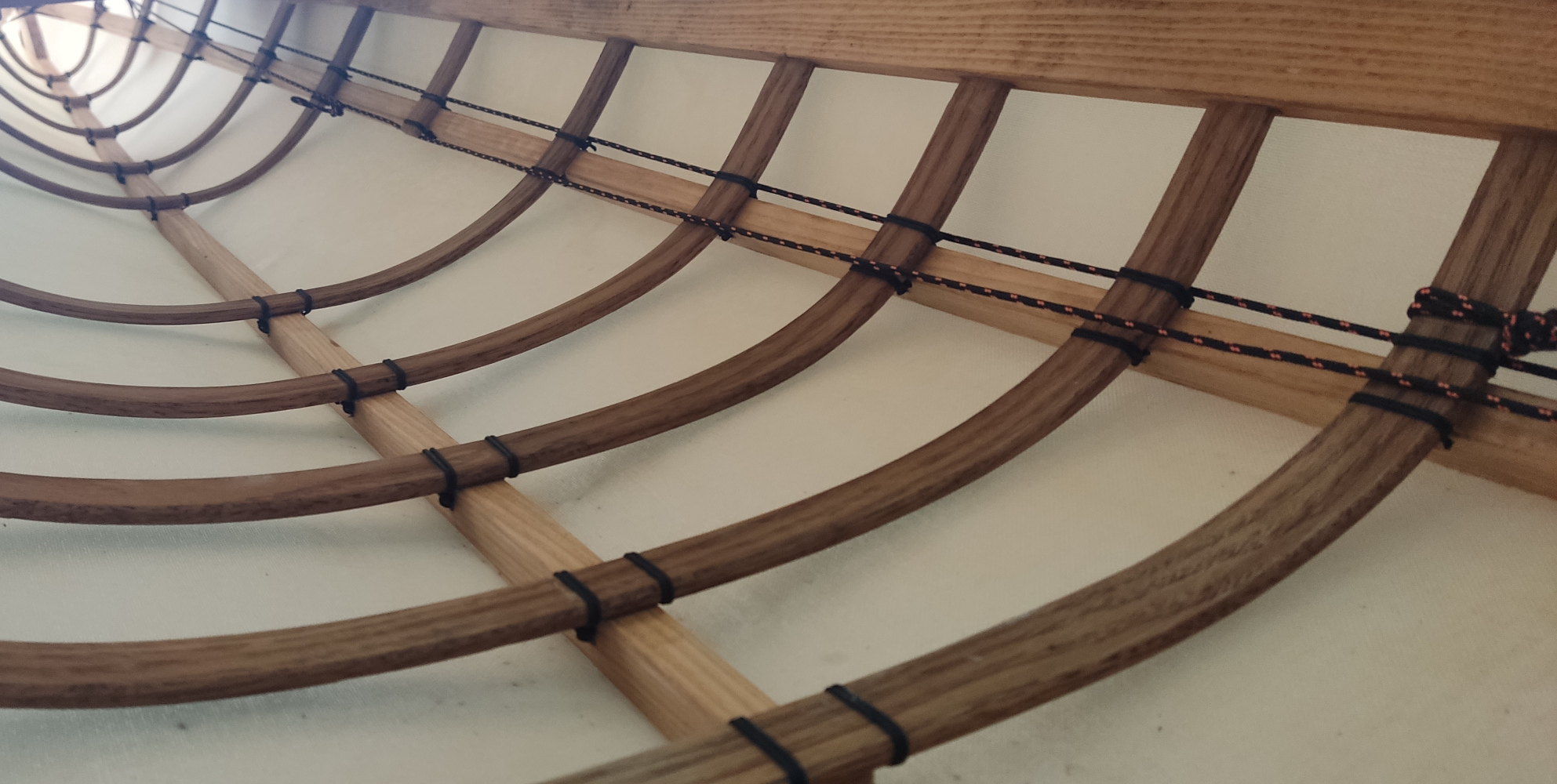
I’ll make a separate detailed post about packing a Greenland kayak and pull cords, but I wanted to mention this here because the front pull cord may potentially create a safety problem since I do not like any type of cords around my legs when I want to exit my kayak! I have tried numerous times to exit from the kayak on land and in very shallow water and have not had any problems. If you are unsure about this for any reason, please remove the front cord. I can always install the front float bag after the frame build, before skinning.
Self rescue in a skin on frame kayak
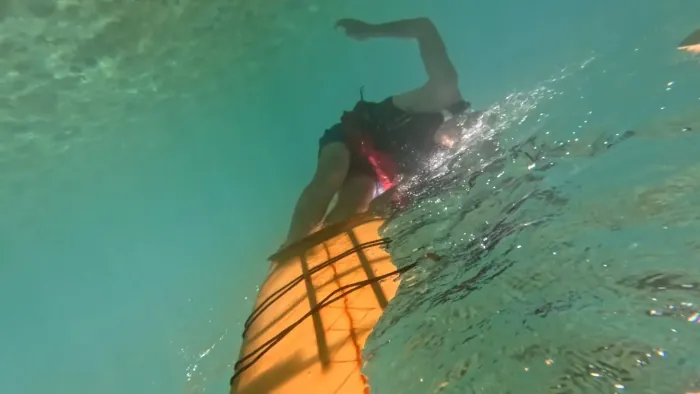
Here is my video where I’m showing self rescue in my totally submerged West Greenland skin-on-frame kayak. This one is my recent build, LOA 520cm, beam 53cm, and it weighs 12kg. :)
I forgot to take my bilge pump with me, but with this method, there is so little water left in a kayak that it does not affect its stability, so you can continue paddling to shore safely to remove the rest of the water with a sponge or use a bilge pump.
A kayak full of water will be a rare case, but it can be seen how fast it can be done. It’s a little harder if you are not standing on the ground, but as you can see, it can be done with a little leg work. :) It’s easier to do this with additional buoyancy, so here is one more reason to wear a PFD.
This type of self rescue is for an unloaded kayak, although with these low-volume kayaks that I use mostly for one-day paddling, it’s also manageable to do it if you are not carrying too many things (I mostly do it with one 5-liter dry bag with personal things and snacks, and a bottle or two of drinking water).
It is good to practice in the conditions you will paddle in. I’m just saying this because you could confront wind or waves. For the same reason, it is good to know this rescue without a diving mask or nose clips. In case you have hard times with sea water and your nose (although it’s good for your nasal passages), exhaling gently through the nose while upside down/blowing bubbles can help prevent water from entering the nose.
This type of rescue is actually easy because of the Greenland paddle. If you know wet exit and how to enter your kayak using a Greenland paddle as an outrigger, you are more than halfway to this rescue. This ‘cowboy’ straddling is easy once you know how to use your paddle as an outrigger.
In the end, there is always risk involved with an adventure, but knowing more about safety and different techniques that can save you will reduce that risk.
You probably heard the famous quote: ‘A ship is safest in a harbor, but that’s not what ships are built for’ - John A. Shedd.