
Skin on frame kayak care
It’s worth mentioning that every type of urethane, even UV-resistant ones, will degrade in the sun with prolonged exposure. The same goes for composite or plastic kayaks, plus they can deform too. Keep your kayak out of the sun in a dry place when you are not paddling it, and this will prolong its life. A garage would be a nice place. A backyard would be fine too, but putting some type of roof over it would be good. It’s good to leave the cockpit open so air can circulate through it.
Skin-on-frame kayaks are not susceptible to rotting, although these kayaks have their frame covered with decking oil just in case. They do not spend all their life in water like boats. The frame is made in such a way that only a small part of it is in touch with the skin, so water is not retained in between. However, there are a few things required for rot: prolonged exposure to moisture, oxygen, and specific temperature.
I made this stand for my kayaks so once the kayak is in this position (picture), all the water (if present) will accumulate near the cockpit. It’s very easy to remove it with a sponge this way.
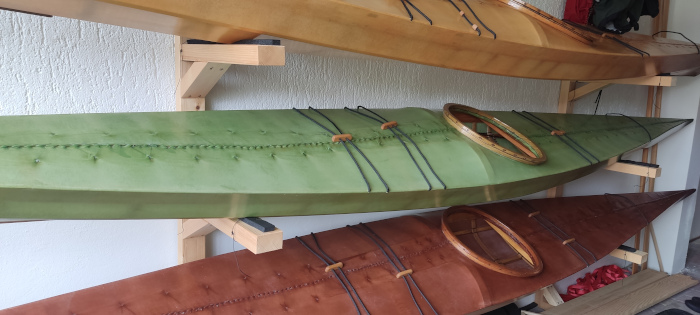
Remove the water from your kayak (it will be dry very fast this way), keep it in dry place and out of the sun after kayaking. It will last for a long time this way.
Protection
Most abrasion happens where the skin touches the frame. That would be the keelson and chines. I usually make oak strips (soaked in tung oil) and attach them with A4 stainless steel screws to keelson ends/stems.
Although there are also some historical kayak examples that had protections on chines too, I do not put them on my kayaks.
Skin on frame thoughness and durability
Can this translucent skin be durable?
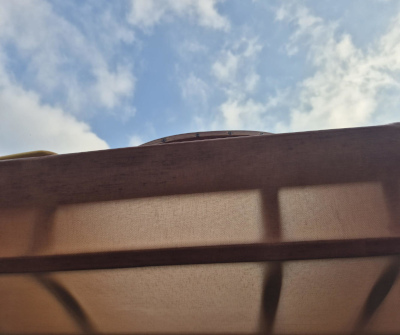
Well, yes. I’ve made a separate blog The Skin - ‘Amiq’ where the skin material is described a little better.
In combination with good urethane coating (with good flexibility and abrasion resistance), these boats become quite tough.
It’s hard to compare with other types of kayaks, but with flexible skin, these kayaks ‘absorb’ impacts. They have great impact resistance, probably the best of all kayak types.
On the other hand, although they are more than resistant enough to abrasion, a plastic kayak would be a winner here. You can haul it through sand and rocks without worry, and at most you will get surface scratches from rocks, but with a kayak weight of 12-13kg, you can easily carry it with one hand.
On the other hand, very sharp rocks or oysters could make a puncture. That’s why skin-on-frame kayaks are nice for sea, river, or lake, but they are not for whitewater.
Tests
I tried to make a puncture with a screwdriver (very hard push and hit) and I did not succeed. I would not go into details with my tests because it’s simply not a real-life situation. There is a big difference when you hit a sharp object in moving water with all of your weight.
The urethane coating that I use at the moment is nice, UV-resistant, and has good flexibility, but it’s a one-component alkyd urethane, and repeated abrasion is something that could be better after my tests. That is something I’m constantly working on, and I’ll switch to something a little different soon.
Greenlanders reskinned their kayaks every year or two. The seal skin was rotting, so it was needed. With modern materials of today, the situation is much different. In the end, once the skin is all beaten up, with reskinning of the kayak, you get a new kayak. That is something you can do yourself, and I’ll make a separate post about it.
Update
I finally found a great aliphatic urethane coating, so you may want to check out my ‘New skin on frame coating day’ blog.
Repairs
For quick/on-the-water repairs, I always bring a few meters of duct tape with me, although I have not needed it so far.
Punctures can be sealed with urethane or SMP (MS Polymer) based sealants. I experimented a little, and Bison Poly Max high tack express is a good one.
It will stick well to urethane, but keep in mind that urethane alkyd (and probably most urethanes) varnish will not cure well if you cover it over SMP-based sealant.
I’m mentioning this because maybe you would like to do it with urethane varnish. If you go this route, it’s better to slightly sand the place with the puncture and apply a few urethane coatings directly over it without sealant. Urethane alkyd varnish is usually thick enough to cover small punctures.
I’m constantly searching for better coating options on the market, so I’ll give more details about it once I settle on one, because not all urethanes will stick well to already cured urethane coating.
The worst-case scenario would be a tear in the skin. It happens very rarely, and I haven’t heard of it happening to anyone. In this case, it would be necessary to stitch this place with a curved upholstery needle and fishing braided line (eventually fabric patch) before applying urethane/sealant over it.