
New Skin-on-Frame Coating Day
Besides finding a good skin material, finding a good coating took a considerable amount of time. As mentioned earlier in my ‘Skin on frame kayak care’ blog, I used alkyd urethane coating for my kayaks - the best I found, ‘marine grade’ - but then again, it’s alkyd-based and resistance to abrasion could be better. It’s a common situation that people use these coatings for their DIY skin-on-frame projects and you get a nice kayak at the end, but resistance to abrasion is usually not so good in comparison to some better solutions. Will it paddle? Yes! Do I need a better coating for myself? Probably not. My one-year-old alkyd urethane-coated kayak holds up well and all I’ve got are some surface scratches and one bigger one on a sharper rock. But the kayak doesn’t leak anywhere and even if I get a leak, I can easily repair it with a little bit of sealant.
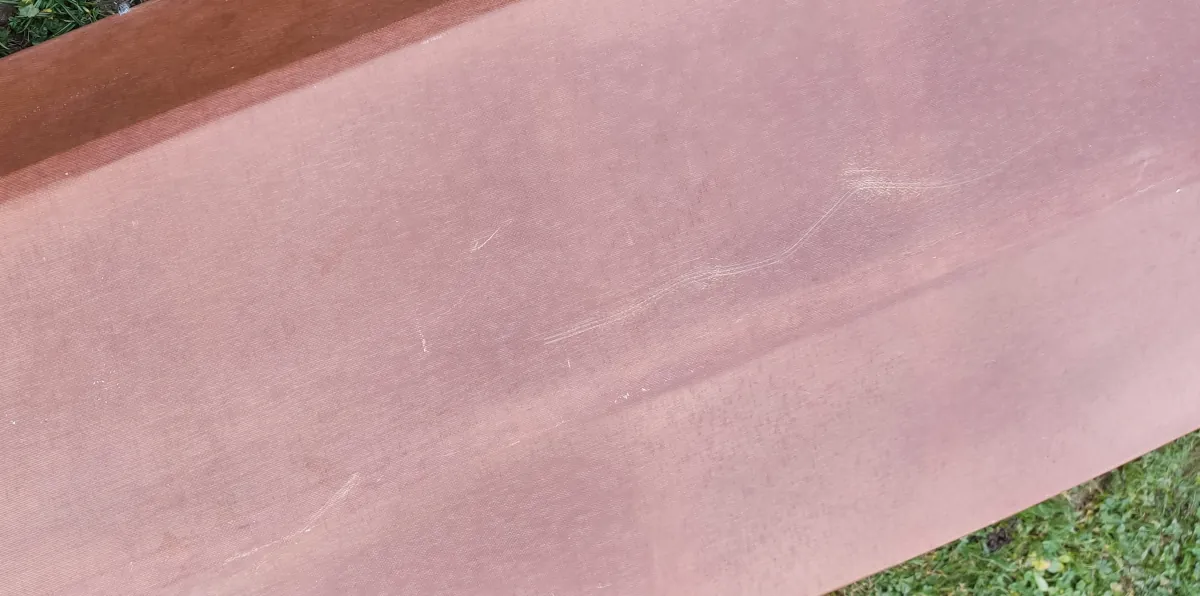
Abrasion tests of alkyd eurethane
In my 14-day test at sea, one of my kayaks was left on a slipway next to the beach two or three times a day for a few hours, and the other one went through a similar test but for a few days less. The kayaks were moved here and there by waves, so I found it to be a great repeated-abrasion test (something that skin-on-frame kayaks are not so good at). At the end, as I thought, the kayak keelson and chines got really fine abrasion, but the rest of the skin was like new. Coating at the keelson and chines near the sitting position came off fully in some places, down to the skin. I did not inspect how much abrasion happened on a daily basis. I should have done this because I could have ended my tests sooner maybe, but it doesn’t matter now. Something happened that I expected. On the other hand, I was actually happy because of my skin. It was like new in these places. In case abrasion had happened on the skin, you would see a little bit of ‘hairy’ parts because every yarn of these fabrics is made of many filaments. These filaments could be seen if you rip off one yarn or if you go over the fabric with sandpaper for a longer time.
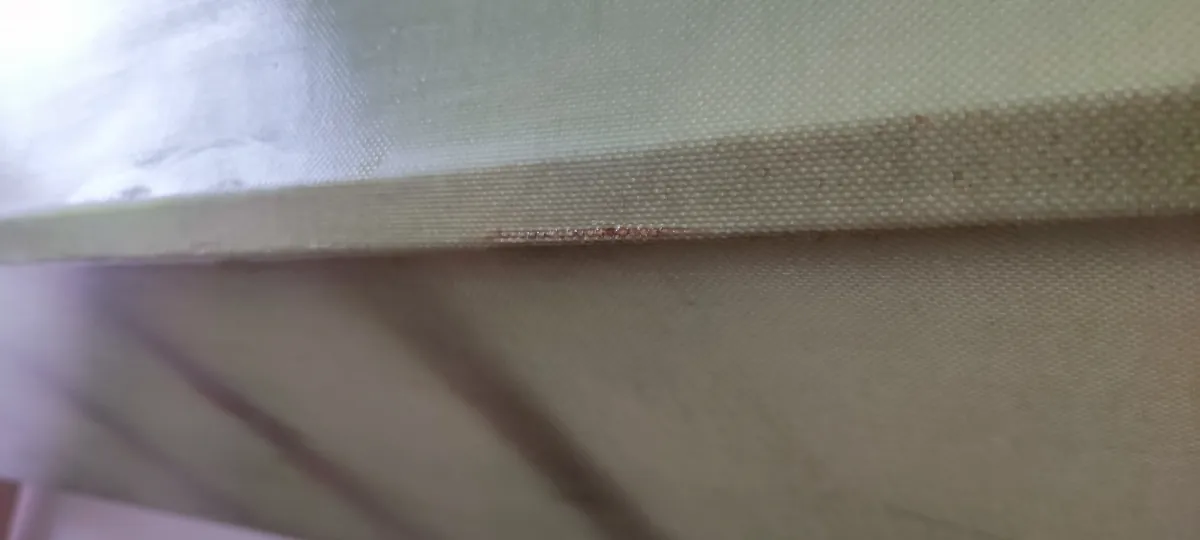
Something I missed is that I did not take photos at first, and the kayak that was on the slipway for a longer period of time has been reskinned and I’m finishing it with a new coating. So on this one I already fixed it by slightly sanding it and doing the recoat on this part with alkyd urethane. Again, this one was on the slipway for a shorter period of time and the situation on both kayaks was similar, but on the first one, abrasion took up a longer part of the chine and keelson. I did not use pigment, so the fix is visible.
Back to coating, I started to look for a better solution - a better match for my skin.
Skin-on-frame urethane coating properties
There are a few main things next to abrasion resistance which I tried to cover during my search for a new coating. It needs to be flexible (some urethanes are more flexible and some of them less flexible) so it will not crack on impact. That’s the reason why epoxy (in case you were wondering why not epoxy instead of urethane) is a bad solution for skin-on-frame kayaks. Most epoxy products have poor UV resistance, they will yellow in the sun and need UV-filtering urethane coating if you want to protect them. A thin layer of epoxy over flexible skin would crack on the first impact. Further, urethane coating viscosity should not be too high because the first coat needs to ‘saturate’ the skin, bite into it, so delamination can’t occur. That’s why it’s good to use a little bit of thinner in the first coat or heat the urethane before application to lower its viscosity. Be aware of heating the urethane because you will reduce the pot life this way. Using smaller batches during coating is a good solution for this problem. ;)
UV stability - it will last longer. Loss of flexibility, discoloration or surface cracking is less likely to happen.
Leveling - nice leveling is preferred.
High volume solids - most are not 100%, but can be very close to it. What you put on your skin mostly stays on it once the coating is cured. ‘VOC free’ product. A very nice property because with 50% volume solid alkyd urethane (50% is pretty high for alkyds), I needed to do 7 coats for my kayak!
It’s no secret that Coelan boat coating (aliphatic urethane coating) is one of the best solutions for covering skin-on-frame kayaks. It’s a very toxic product. Based on VOC (this thing evaporates, right?), which is 38.70%, I don’t think volume solids are much higher than in typical alkyd-based urethane. I did not find this information in its specifications so I’m guessing it based on VOC, maybe I’m wrong.
Most of the two-component solutions that I tried I was not satisfied with. They had similar abrasion resistance as my new coating but either they were too hard and not flexible enough or they had low volume solids.
Having said that, I would rather use alkyd-based coating with lower abrasion resistance which I can repair easily than having a non-flexible urethane which will crack.
Back to my coating.
So even if my new coating is a ‘VOC free’ product (also aliphatic urethane), I found that it has some solvents in it so something will evaporate. I should rather say ‘nearly VOC free’. Anyway, you should always wear a respiratory mask (to get this Breaking Bad Heisenberg look!), gloves and eye protection while applying it and during the curing process.
I’m not so into chemistry, but one thing I found was interesting, so I searched a little bit. The thing is that if your coat is too thick, it will cure, mostly in a 24-hour period. This is not the case with alkyd urethanes. On my first kayak I had a spot behind my cockpit where the coating was too thick. I needed to wait for days until it cured.
So, even if it’s a one-component urethane coating, this aliphatic urethane is moisture cured (moisture-driven isocyanate reaction) in comparison with solvent-based alkyd urethane which cures by oxidation. Moisture diffuses very well through urethane while oxygen struggles to reach deep layers. So yes, it can be applied ‘wet on wet’, actually it should be done this way. I’m doing the first two coats (with pigment) plus one clear coat wet on wet. This third coat will usually cover the skin texture in most places, but there will probably be places where the texture is still visible. Once this cured, but not fully, I’m going with a fourth coat. Although the maximum overcoat time is around 24 hours, I usually wait for a few hours, while the coat is more stable and still tacky (4-6 hours). Additionally, having a one-component urethane, there is no need for mixing anything besides pigment in it. You will want to stir a newly opened can a little bit before use, of course. I’ll probably make a blog about covering the skin, with more details in it.
A brush or roller can be used. I’m still experimenting with a scraper card, we will see. I did not try spraying (the finish would probably be even nicer) but spraying is more hazardous, you waste your urethane (I like more paint on my kayak than around it, you know) and I don’t think that the first saturation coat will penetrate into the skin well with spraying. With a brush, roller or scraper card, you can ‘squeeze’ it into the skin.
So here it is, high solid, one-component fully aliphatic urethane coating. With great abrasion resistance and flexibility. It’s non-yellowing, does not yellow over time, fully transparent coating and UV stable.
Colour difference
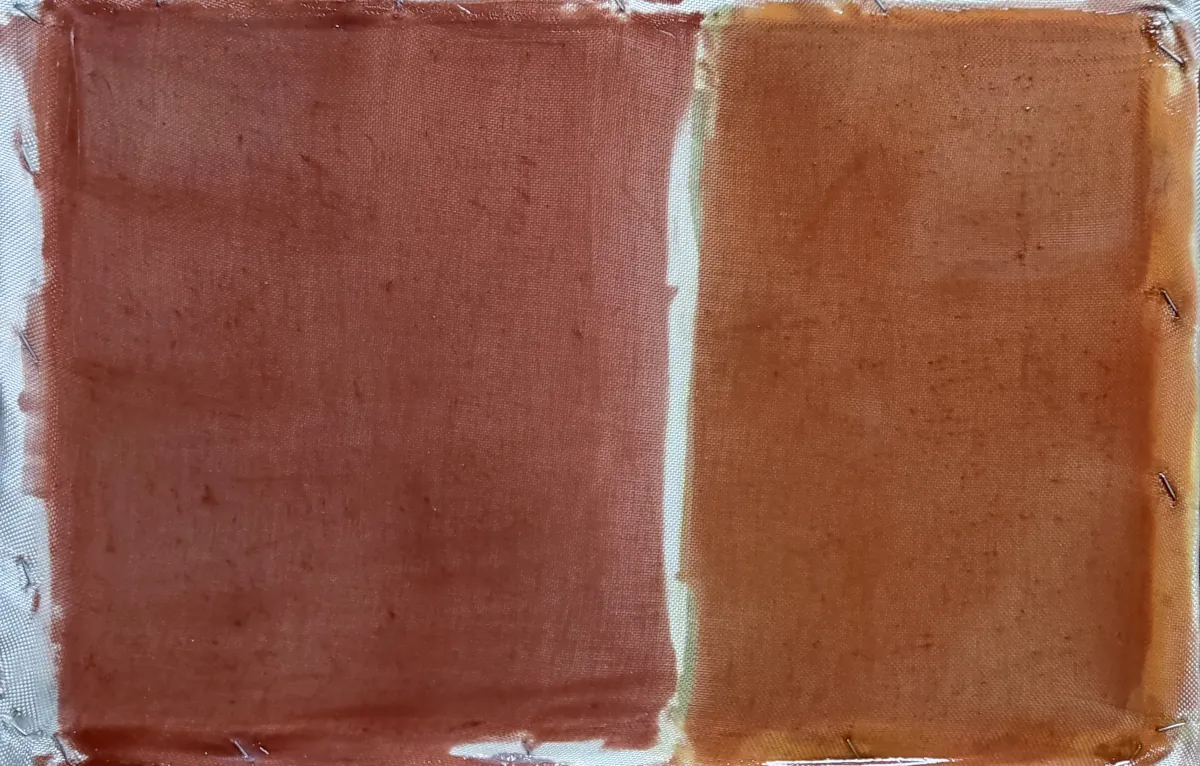
“I took burnt umber earth pigment for my tests. Probably the nicest earth pigment for me. The pigments that I currently use are in my ‘West greenland kayak’ gallery. The image underneath shows the difference in color. New aliphatic urethane coating on the left and old alkyd urethane coating on the right with the same pigment. It’s hard to say what is nicer - pigment mixed with aliphatic coating has a more true color, but ‘yellow-saturated’ pigment mixed with alkyd urethane is also very nice for me. The thing is that aliphatic urethane ‘unlocks’ more pigments. I had one more pigment, ‘Umber Dark Ardennen’, which was appealing to me but I could not use it as it always ended up too greenish when it was mixed with alkyd urethane. I can finally try it :) There is also an option for a ‘fully white’ kayak without pigment now.
Thoughness, puncture and abrasion resistance
I used a Phillips screwdriver for puncture tests. In my Skin on frame kayak care blog, I wrote that I tried to make a puncture and I did not succeed. Well, my friend came to my workshop, tested my alkyd urethane sample and he did make a puncture with a Phillips screwdriver. I almost started to cry! So it can be punctured, but you need to push really, really hard. At the end, I did it too. The situation is similar with aliphatic coating too but you need to apply additional force (I made a hole on the second and third try) in comparison with alkyd urethane coating. And yes, skin-on-frame kayaks do not like very sharp and very narrow objects. The screwdriver test is not the best, because even if I can’t make a hole, it’s a different situation when you hit it in a kayak with all your weight. On the other hand, how many screwdrivers or screwdriver-like objects you find in nature?
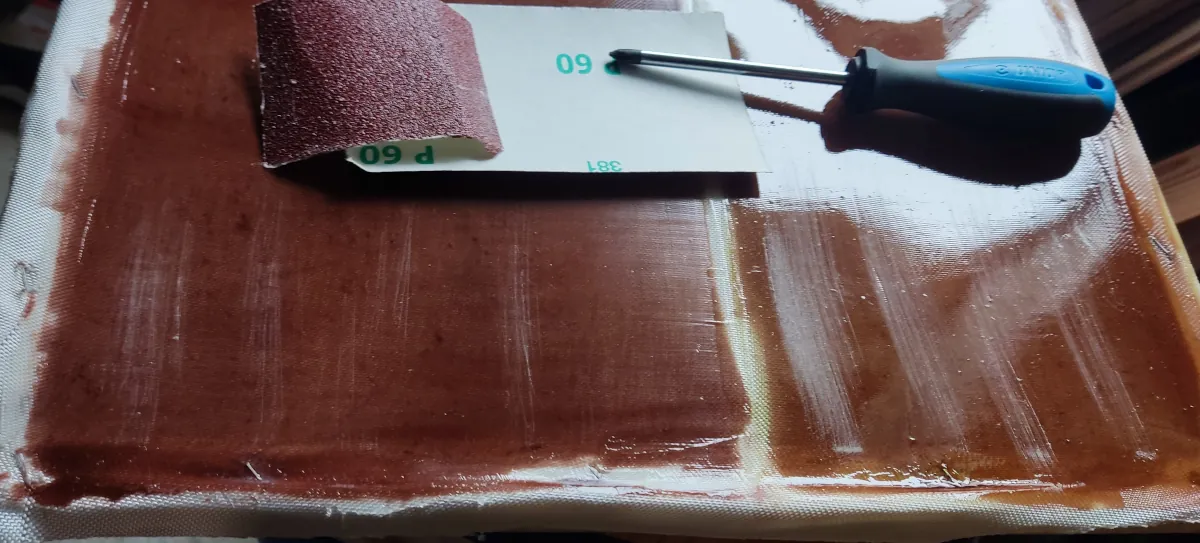
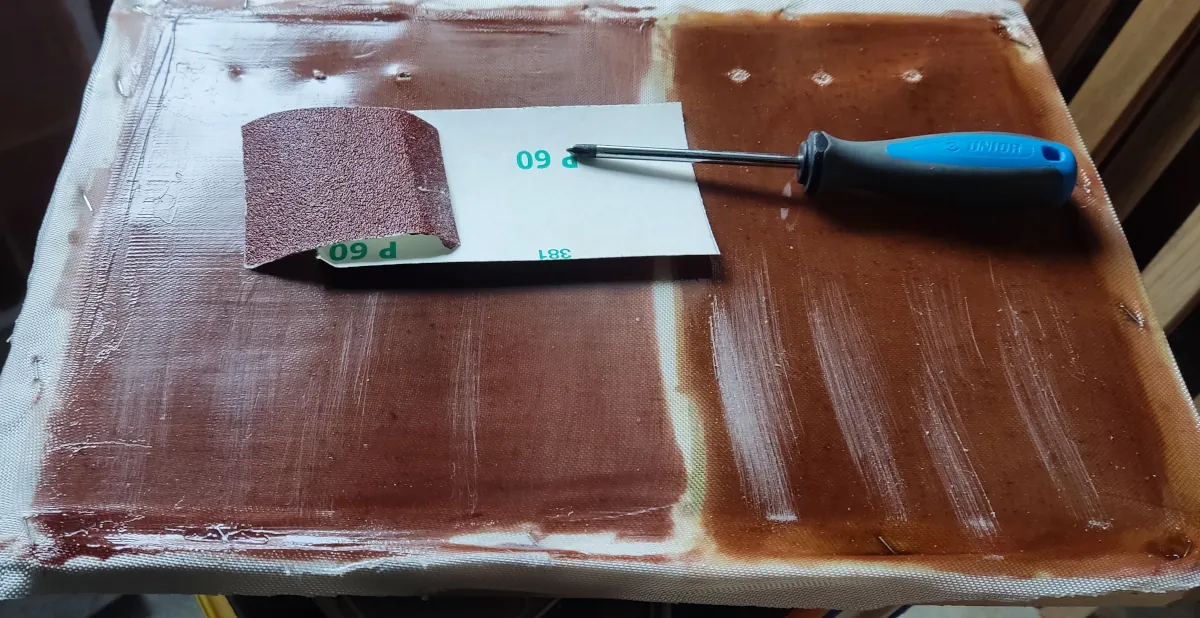
I made four tests on both coatings with 60-grit sanding paper (the roughest I could find at home). I tried to use the same force on all tests, but the number of strokes applied went from more to less, with an equal number of strokes for each test on both samples. This is something I was hoping for. Aliphatic urethane got mostly surface scratches on every test. With the absence of light, tests with fewer strokes are hardly visible at all.
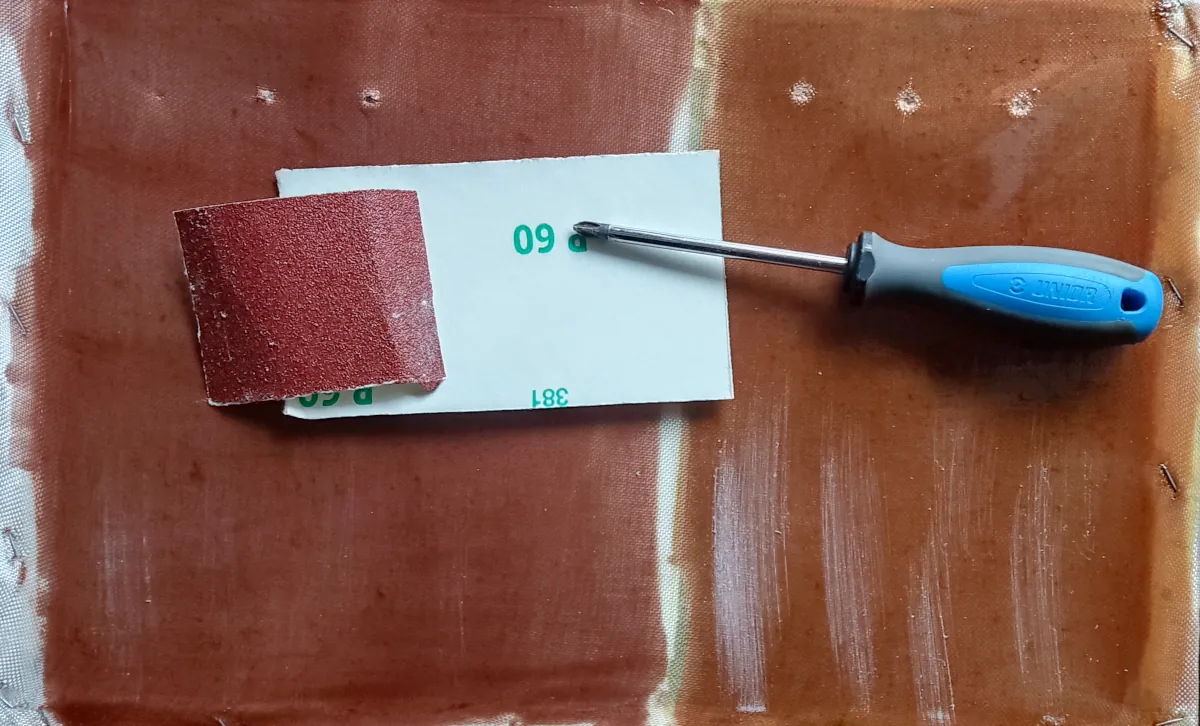
The next two images are made from a different angle, with more light and scratches are more visible. So yes, there are scratches on aliphatic urethane coating too, but much less - more surface scratches than peeled-off coating.
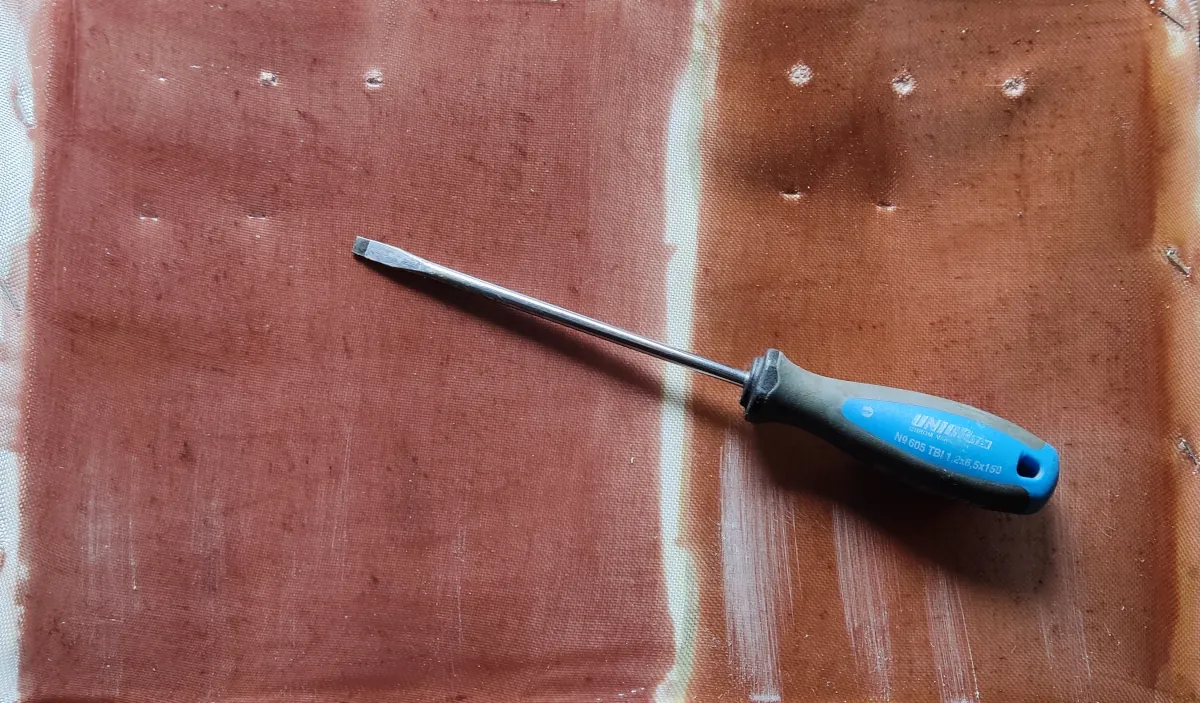
Flathead screwdriver - there are more fabric yarns under the wider flathead screwdriver and the result is that I did not succeed in making a hole even with extreme pressure on both samples. With the increasing surface of the object hitting the skin, this is where skin-on-frame kayaks start to shine - impact resistance. With the flexibility of skin and coating, they will absorb impacts. In most situations, they will probably outperform all other kayak types.
Flexibility
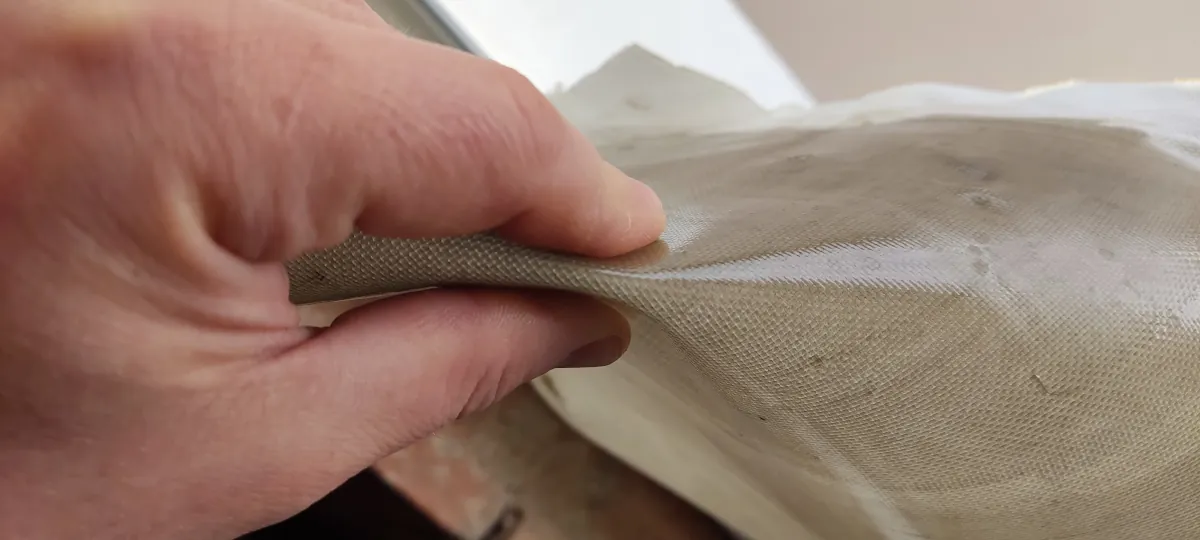
This is one more sample I made with new aliphatic urethane coating where I tested the new ‘Umber Dark Ardennen’ pigment. I think this picture tells enough about elasticity. Additionally, the puncture test shows it also, because the coating did not crack around the puncture.
All of my test samples are in my workshop so feel free to come and check them out for yourself ;)
At the end, with good skin and urethane coating, a skin-on-frame kayak can withstand a long period of usage. If you are using it intensively, this period will decrease for sure, but there are a lot of skin-on-frame kayaks which are 15-20 years old and where the skin still holds up. Not to mention if reskinning is done, you basically have a new kayak.
Although I’ll do on-the-water tests too, the things above are telling me that I finally found the product I can stand behind.